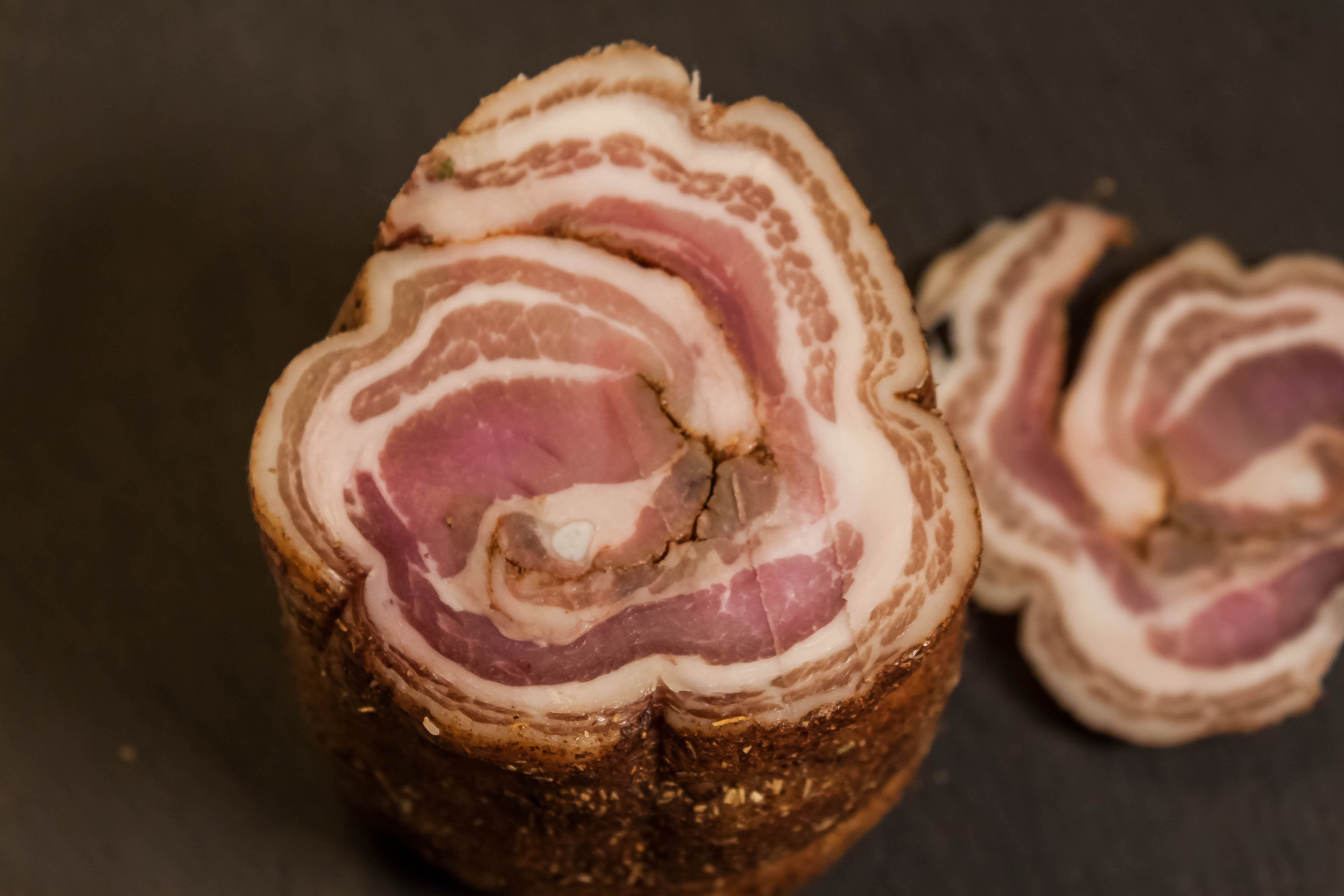
Coming across a product used in the food industry, I thought to give it a try with a second run for a pancetta. after wrapping one before traditionally in cheese cloth.
It carries some usable features: better visual control on your goods during curing, after a week the foil shrinks close to the surface of the goods, but removable by previous wetting with a sponge.
The aroma of herbs is sealed better than traditionally. The evaporation in the drying process using collagen foil is slowed down, however this also depends on the level of humidity inside the curing container.
I certainly will use it on smaller pieces of meats, like duck or goose breast to receive a throughout uniformly grade of cure. Smaller pieces have the tendency to dry faster on the surface if cured in a cheese cloth.
Any other, I haven’t detected a superiority over the use of cheese cloth in hygienic conditions for air drying. Testing it for dry aging without brining is still on the list, could envision the loss on cut offs, after 30 – 40 days aging, is considerably less.
Can be used for cold smoking (20° C - 25° C). I will give it a try in early spring, and expecting results comparable to cold smoked Salami, using artificial guts.
At temperatures over 60° C, the foil is irremovable and permanently attached to the goods, the primary feature attracting its use in the food industry. Since the base material of the foil is the Subcutis, the last layer under the beef skin, I suppose extended cooking time will dissolve it at one point around 60° C. or above. Max temperature recommended by producer is below 90° C. for short scalding.
5 Weeks in collagen foil