Go to the Recipe: Ultimate Roast Porchetta
Made this for Christmas '25 as a break from our yearly honey-baked ham. My Dad now has "herbacious" in his vernacular, so I don't think we're going back. Plus porchetta leftovers used for ragu is far superior to a cold ham sandwich. I had to sub two tenderloins for a single loin, but I think it worked out perfectly well.
P.S., when heating up the leftover porchetta from the fridge removing the skin and putting it in the oven at 425/450 on a wire rack it puffs and crisps 100%. No added fat needed.
This was a hit for Christmas Eve
Nicely done! Looks great.
Cooked it twice already. Difficult cut to get. Seasoning is fenomenal balanced.
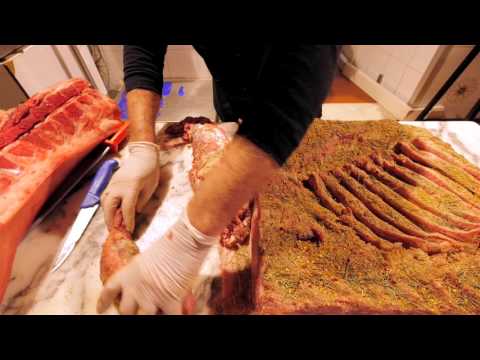
The butchering video alone is a masterclass!
I have a porcelet skin-on belly and I want to use the sous vide method for my porchetta. Should I remove the skin before hand?
Has anyone thought of adding to pork rind on the sous vide porchetta to create the crackling after the water bath cooking? Would it work or would the high temp end up rendering too much fat? I'd be keen to try but would love other people's perspective on this
Hi! Why not some neutral oil on the pork belly skin before cooking? Some chefs do it and some don’t. Kevin didn’t in this recipe and the skin looks amazing.
Can you score the skin before air drying? It looks a bit hard to score dry.
Pork and chicken skin are very different in terms of texture, thickness, and how they behave during cooking. In the video, you can see how leathery pork skin becomes with dry-aging. Even when it's dry-aged, air-dried, or dehy'd, you need it to retain a little moisture content so that when it's roasted or deep-fried at high heat, that moisture rapidly converts to steam, puffing the skin and turning it into crunchy crackling. Without that moisture content, pork skin crisps but takes on an unpleasant, stick-to-your-teeth chewy texture. If you start the roast porchetta in a low oven (without any steam), the skin will completely dry out, and by the time you blast with high heat at the end, it will just turn into a jawbreaker. Chicken skin, by comparison, is very thin and delicate, so you don't need to take the same approach.
Salt helps retain moisture and you'll need that extra salt to avoid dry and chalky pork loin, which will be overcooked after so long in the oven at those temperatures.
I think we have to choose between perfectly salted dry meat (around 1% salt by weight) or slightly over-salted juicy meat.
I see that you used the iCombiPro in your cooking process, but didn't utilize the steam-function at all - I imagine to make this accessible to most home cooks.
However, do you happen to have a cooking profile that does utilize the iCombiPro's steam capabilities? I've seen Italian chefs cooking porchetta overnight (8+ hours) in their Combi's (ex: https://youtu.be/o5qJ3MAPxS8?si=F6g_z47zFlQwq-1p&t=281) that start with steam, and then use a dry-heat cycle at the end that creates an incredibly fluffy chicharrone-like skin.
If you have any experience similar to the above, I'd love to know!
Hi! I'm wondering why you go for first high heat then low heat, while for the ultimate roast chicken (also with pre-dried skin) you take the opposite path. Thanks!
Could it be to do with the sous vide vs oven cooking approaches? Possibly more salt is lost when cooking over a rack?
Grant did comment on the salt levels too, so perhaps it's simply a saltier recipe.
This. Is. Beautiful. *single tear*
I love allums. they don't love me. Can I substitute the greens of green onions or garlic chives or ?
I'll venture a guess that the skin weight is considered into the equation.
What's the reasoning behind the different salt percentages for the belly and loin porchetta, v.s. the all-belly porchetta?