Go to the Recipe: Potato Burger Buns
These look so good! Great work.
I love the addition of amylase. I refrained from using it here for the sake of user-friendliness, since the dough is already quite slack without.
Really nice shaping. 💪
Great recipe.
I added 0.1g of Amylase enzyme to the dough. Not sure if it was actually necessary. Bulk fermented in the fridge overnight as a large mass then shaped the following day Incredibly soft with a ever so slight chew and good flavour.
Hey Tim,
Thoughts on adding 1g of Amylase enzyme to the dough for improved texture/shelf life?
Cheers
Definitely! In fact, Andrew, Sasha and I worked together for years. I often look to Andrew's recipes as launching points for initial testing and comparison when I start a new bread project.
For this recipe, I compared his recipe, another recipe from Andrea Geary at Cooks Illustrated, and four other strong contenders (like this one, and my own notebook recipe from my bakery days). Based on those initial tests, I liked AJ's the best for flavor, but I had some quibbles with the hydration, dough handling, and the look of it. His recipe uses a bit more potato and flour than mine, which gives his buns a slightly more wrinkled appearance and a more open, lean crumb.
I adjusted ratios and added an egg, which seemed to tighten the crumb in a nice way; it also added back some structure and seemed to solve the wrinkling issue to an extent.
This brings up an important point about recipe development: We always have to start somewhere, and we often start with proven, trusted recipes as a reference point (especially for baking). The goal is never to plagiarize, but always to iterate and improve in thoughtful ways—and to back it up with sound testing, every time. The process might sound derivative and tedious (it often is!), but that's the game we play.
Definitely! In fact, Andrew, Sasha and I worked together for years. I often look to Andrew's recipes as launching points for initial testing and comparison when I start a new bread project. For this recipe, I compared his recipe, another recipe from Andrea Geary at Cooks Illustrated, and four other strong contenders (like this one, and my own notebook recipe from my bakery days). Based on those initial tests, I liked AJ's the best for flavor, but I had some quibbles with the hydration, dough handling, and the look of it. His recipe uses a bit more potato and flour than mine, which gives his buns a slightly more wrinkled appearance and a more open, lean crumb.
This is actually an important point about recipe development: We always have to start somewhere, and we often start with proven, trusted recipes as a reference point (especially for baking). The goal is never to plagiarize, but always to iterate and improve in thoughtful ways—and to back it up with testing, every time. The process might sound derivative and tedious (it often is!), but that's the game we play.
Hi ChefSteps team! Quick question, and I truly mean this in the best way. Was this recipe adapted from or inspired by Andrew Janjigian’s “Martian’s Potato Bunz & Bread”? It reads very close. If so, it’d be wonderful to add a quick mention or credit so readers can trace the source.
Made these. They turned out great. My wife loved them and normally she’s the burger bun maker.
BUT… dear god. Firstly - the 3-1/2 hour “total time” estimate is a farce unless I’m missing something. This is all using the minimum times assuming almost instant prep:
Potato boiling: 20 min
Potato cooling and mashing and wet ingredients and flour adding: 10 min
Rest 1: 15 min
Kneading: 15 min (took >20, more on that later)
Proof 1: 60 min
Chill dough: 120 min
Divide and rest: 30 min
Smoosh and Proof 2: 45 min
Egg wash and bake: 30 min
———————————-
5 hours and 45 minutes
And it would be longer if my kitchen was cooler (e.g. Proof 2 is estimated at 45min to 90min). Am I crazy?
OK, as others have said: this is a really slack dough. After 10 minutes of my Kitchenaid working its little heart out, I did window pane tests followed by dough resting and 2 mins of additional mixing. I lost track after 20 min of total mixing (plus resting time intervals)… this dough is a challenge to get a good windowpane.
So… a little update on the timing estimate (so those of us that start the recipe at 2pm don’t delay dinner until 9pm), and some more advice on the mixing/kneading step please.
Hi Dan,
Thanks for your reply, your logic seems to be reasonable, I'll give it a very unprofessional try 🙂🤞
Not Tim, but since butter is roughly 80% fat with most of the rest being water, you’d likely want to do 80% of butter weight in oil, and then add in more water to account for the water in the butter.
So maybe try 40g oil and add 10g water? Just my very unprofessional thought
Hey @Tim Chin. I've been looking for a dairy free potato bun recipe and this seems to be almost right up my alley. Could this work if I substituted the butter with equal amounts of neutral tasting oil? Thanks!
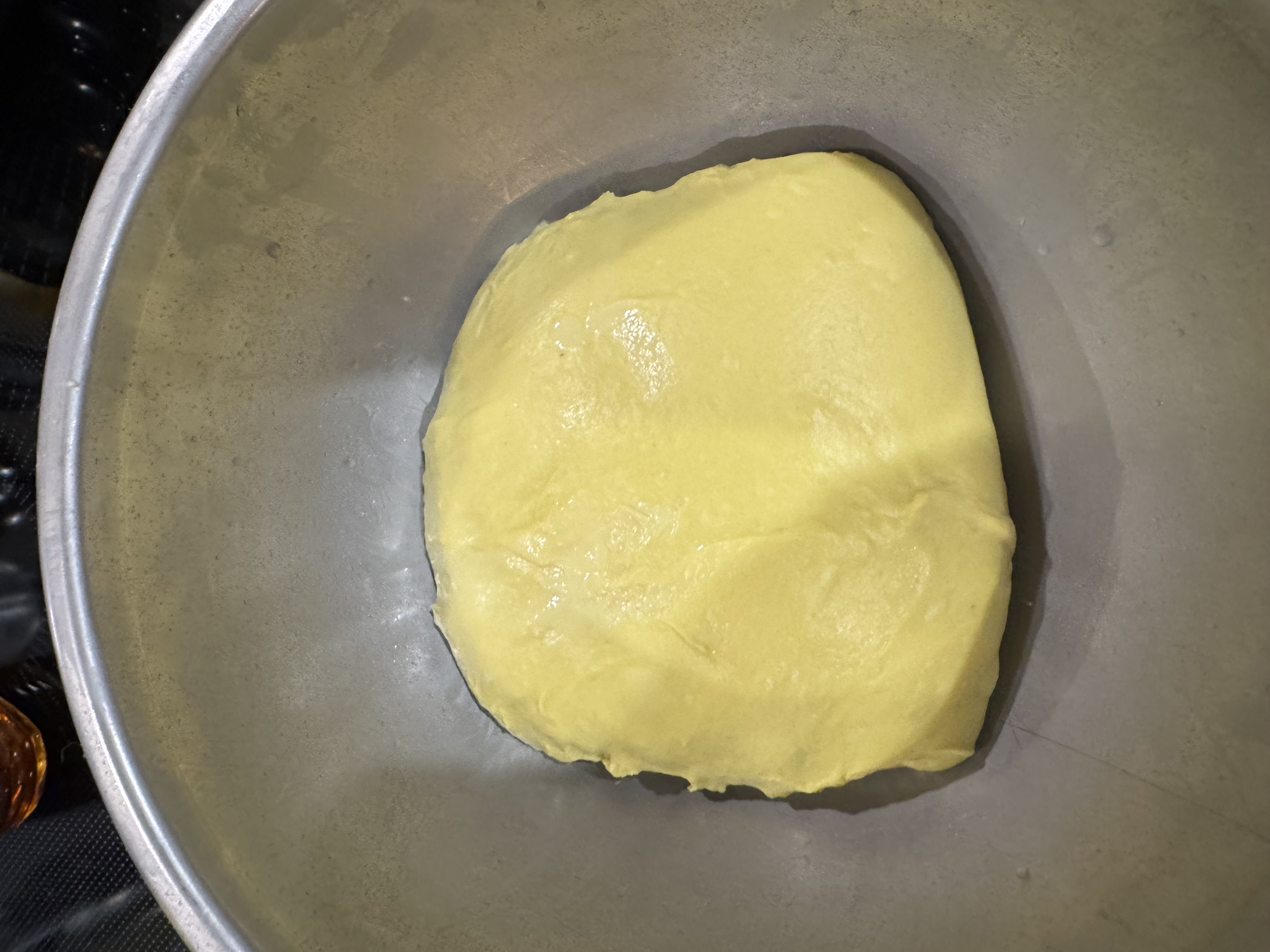
I’m making the recipe right now and also experiencing issues with it not taking only 12 minutes. I have a KA Professional 6 quart 590W and after 12 minutes, it’s still very sticky, sticking to the bowl, and not passing the windowpane test. My poor stand mixer is wobbling all over the place 😂 I measured out the 240g of cooked potato as well as the liquid so the ratios are right, but for some reason it’s just not coming together. I’m letting it rest for 10 minutes since at this point the dough just needs the break as you suggested. Will report back later if that helps.
Edit: I think resting and mixing for another 10 minutes or so got it to pass the windowpane test, although it never quite pulled away from the bowl. I weighed the dough between folds and it was about 840g which is confusing given your 870g yield. Not sure where that 30g discrepancy would come from—I measured very meticulously as I do with every Chefsteps recipe. I wonder if it was water loss from the hot potatoes still steaming? Could also just be what stuck to the sides. Anyways, it’s proofing now. Here’s hoping it still turns out ok! Not totally sure if my stand mixer survived that one 😅
After coil folding:
You can definitely try this strategy. Active dry yeast tends to be a bit slower in terms of proofing time, about 20min longer for each step of proofing compared to instant yeast.
Good luck!
I haven't tested into using gluten free flour(s) with this recipe, unfortunately. One challenge here is limited dough structure inherent to all potato doughs. So if you're exploring GF flour blends, I'd look to blends containing xanthan gum, pure starches (such as tapioca starch, wheat starch if you can tolerate it, etc.), and added proteins (pea protein, whey protein) to facilitate browning and flavor development. Short of developing your own blend, I've had some success using King Arthur's GF Bread Flour Blend
Hope this helps!
Hi Beau and Keith,
Wow, looks like you all went to war with this recipe. Let me try to break things down and troubleshoot.
@Beau
1. Did you weigh out 240g of cooked potato and 100g of potato cooking liquid after Step 1? Those are measured amounts for Step 2 onward. Based on that, I have these gram amounts for dough:
240g cooked potato
50g butter
100g potato liquid
.5g turmeric
40g honey
50g egg
400g bread flour
8.5g yeast
10g salt
Perfect yield would be: 899g
Over successive trials, in real world conditions I was getting a dough yield between 870 and 880 grams. Assuming a bun size at 105g, that leaves 30-40g excess
2. Salt % is a tricky one here, but I should note first that it's actually 10g of salt in the dough (1g for the eggwash). For potato doughs, we have to factor in the potato material in addition to the flour. So we have 400g flour + 240g potato. If we assume that mashed potatoes are at max, ~80% water, then you're looking at around 20% of 240=48g of potato material. If we treat potatoes as flour (starch), then we have 448g of "flour". 10/448 is roughly 2.2% salt, which fits within your criteria (guidelines are generally 1.8-2.2% salt)
@Keith
Based on your comment and agreement with Beau, it seems that you may have incorporated too much mashed potato into your dough as well? What was your final yield on dough weight?
If that's not the case, and you followed the recipe to a tee, and you experienced extended kneading time and stickiness, then I have some suggestions. First, I should note that potato doughs, no matter the recipe, are notoriously slack and sticky. They're hard to work with! Extended kneading is necessary here, but not to the degree you describe. I found ~12 minutes to be sufficient. If the dough is still sticky and doesn't clear the bowl, you can try resting the dough for 5-10 minutes, then continue kneading (letting time develop gluten).
Re: shaping and dough handling, I find it best to chill the dough down as much as possible beforehand after the bulk proof. If the dough really sticks (say, on a hot day), then you can keep the portions in the fridge while you work, between dividing and shaping.
Re: excess for sliders, you should have roughly 230-250g excess dough after dividing and shaping. This is just a reality of this recipe, since the master recipe is written for larger buns.
Hope this helps! Thank you both for the feedback.
My wife has a gluten allergy, but burgers are my favorite food… any experience using a gluten free flour?
I agree with everything you said after making this recipe. However, I didn't add any extra flour. I kept mixing, and mixing. I was so happy that I was at a friends house with their metal geared KA--I think I would have melted the cheaper artisan one) It took so long that I joked to my better half that I am truly questioning everything I have baked if I ever let the stand mixer do its job long enough, because that was excessive.
Even then, the dough was nearly impossible to shape into the balls. (And I chose to make the slider buns, with 50g portions.) :-( I am not a professional chef, but part-time jobs at pizza joints and a passion means I am no stranger to dough, and this was a pain.
I had enough left over for 5 more slider balls, which I was not about to do, but also did not want to waste dough, so I divided into 125g rolls--okay, a C-shape one over with this dough--and into mini loaf pans. Baked the same time and temp.
Despite the pain-in-the-ass dough, I think I will try again. Hopefully we will get some feedback from Tim. It was delicious. Although I don't agree with it being a side-of-fries taste.
Could I use active dry yeast and simply bloom it in the potato cooking water if I allow the water to cool down to a temperature that won't kill the yeast?
Help? I love Tim's recipes and couldn't wait to make this for a dinner party with friends tomorrow night.
I'm making this recipe and the ratio of flour to wet ingredients seems off. This dough is way too wet/sticky after 10 min of stand mixing. I'm a fairly experienced home baker (whole-grain sourdough at 100% hydration regularly) and the ratio of wet to dry seems to be over 100% hydration.
I looked at a few other popular Potato Burger Bun recipes online and found that the weight of flour is equal to — or slightly more than — the weight of all the other ingredients combined.
I also noticed that if salt in this recipe was calculated at the common 2.2% bakers percentage, then the 11g of salt would be for 500g of bread flour… instead of the recipe's 400g of bread flour.
Also, the "divide and shape" section suggests "you should have 8 portions, with a little left over". So if you calculate 8 x 10⁵g portions = 840g. The total dough ingredients weighs 941g… which leaves enough left over for almost another whole bun. With this calculation, I was hoping to find that there wasn't enough dough, but was surprised to find that there was nearly enough for 9 portions.
I've added this 130g of extra flour to my stand mixer and set aside 20g of flour for dividing and shaping. The dough in the mixer with the extra flour is looking much better, but is still a bit sticky. Given my comfort working with high-hydration doughs, I'm gonna roll with it and hope it goes well. Hoping to reply with success. 🤞
Given that there are no other comments on this recipe, perhaps I should have cross-referenced recipes before starting. 🤷♂️ #YOLO If all else fails, burger buns are fairly easy to source at the market.