Go to the Article: Activa aka “Meat Glue”—What It Is and How to Use It
Yes
Can you marinate meat after the cold set method. I'd like to do a reconstructed roast as sauerbraten. Any suggestions that would further this goal also appreciated!
I would like to see an occasional reference distinguishing binders from extenders. I often see bread crumbs, crackers,cooked rice etc. referred to as binders, but they are extenders which actually inhibit binding by physically separating proteins in the cooking process. Cooked cereal starch sources are usually excellent in extending product, preventing rubbery texture and enhancing moisture retention but they do not bind, as any binding properties from proteins, such as wheat gluten have been denatured in the process of cooking.
Binders in cooking of comminuted meat products are most often raw proteins from the meat itself, other raw protein sources such as egg whites, the gluten from uncooked flour etc. which form a structural cohesive matrix in the cooking of these protein sources.
Though the above is a simplification, it is a valid discernment of the general difference between binders and extenders. The optimal applied use of each gives one control of the finished product in texture/tenderness and "moisture perception" in the finished product.
Looking for a recipe to bond soy crumbles into a patty..I used tg with coco oil mixed in to act as a saturated fat...molded good and look and felt good cold and sliced nicely..like ground beef but came apart after heating..maybe adding casein??..thanks
Looking for the recipe peanut-butter noodles from Wylie Dufresne, it is not in his book.
The viscosity of your liquid could also be the issue. Though a liquid is solid due to gelatin the body maybe to thin at high temperatures. A light nape/nape consistency would be the ideal.
Yes.
Yes, especially if not charred. While there are fewer intact proteins in cooked food, and the bonds might be weaker, the casein in RM helps compensate.
will Rm bind already cooked proteins say duck confit
amazon
Hello, I wanted to ask what this was made from as I'd like to be sure that it's compatible for people who have halal/kosher dietary needs? Also is it vegetarian friendly?
Can I use this for Maryland style crab cakes, in place of a traditional bread or cracker crumb binder?
How does this work with brining? Is it better to brine before or after the addition of activa? Or does it not matter because the reaction is largely irreversible? Thanks!
I boned turkey legs, sprinkled with transglutaminase, then place placed one leg on top of the other (wide and think ends opposed), rolled in saran and then in vacuum bag. It's now in the freezer. Will freezing cause the bond to weaken or come apart?
is it possible to dry age transglutaminase glued beef? That would be incredible for smaller Cuts like Picanha and so on? So in theory: take 5 to 10 400g pieces glue them together and age it? Would help to set the cut off's to a minumum...Could work?
Where to buy in New york¿ please¿
cheers
Activa RM
I do shrimp Spaetzle with Activa. It's very simple and fast. Grind 500 gr raw shrimps in an meat grinder or food processor mix in 1/2 sachet gelatin in 15 ml lucky warm water and 1.5 to 2% Activa. Let stand for about 20 to 30 minutes. Heat 1.5 liter water to 60 grad Celsius and with a Spaetzle press make your Spaetzle. I than make some zoodles cooked for 1 minute in the water you did for the Spaetzle, mix all together with some fennel seeds..
Or possibly something along the lines of this.
Transglutaminase allows for the development of entirely new products, e.g. protein films used to coat fresh vegetables and fruits and processed food products to extend their shelf life and freshness (Di Pierro et al. 2011). Whey protein modified with transglutaminase is used to produce such films. These films are edible and may be consumed together with food products (Marquez et al. 2013).
Although a practical method for implementing these ideas I'm not sure of.
Hi, I'm trying to get a more consistent result from a liquid center meatball, no leaking, and was wondering about outside setting, as talked about on Dave Arnolds website with the example of Dufresne's shrimp noodles being set at 54.4 C. Would just dusting a meatball with Activa and then setting create a more consistent less permeable "skin" or would I need to actually incorporate the activa into the mixture. I guess I would prefer to avoid the "snappy" texture throughout the meatball is why I'm asking about the sprinkling.
Have you guys played with this more? Ive been making the veggie burgers per your recipe, but we are wanting to switch to a vegan burger. Are all activas the same? I read that TI is vegan, is this true? and Im switching to a soy protein isolate instead of the caseinate. What are your thoughts on this? I could really use the help.
When is come to storing modernist powders like ULTA-TEX 8, will keeping them in the freezer harm the product? this is in regard to shipping if anyone knows?
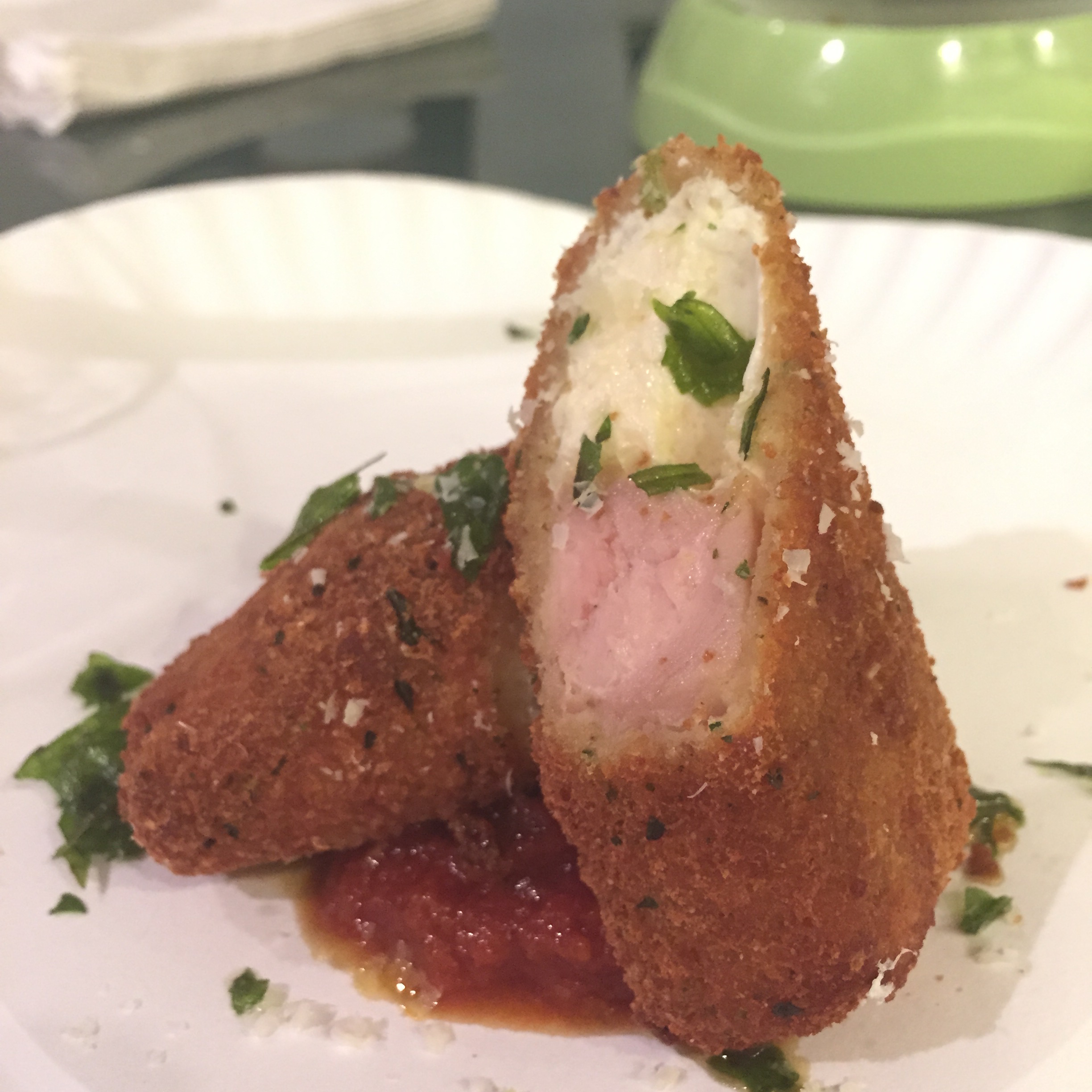
Chicken Parm, Inside Out / Extra Fancy Mozzarella Stick
Glued thighs together into a big brick, cooked sous-vide and pulled a block of mozzarella into the same shape. Parm in the breading and again to garnish.
I used egg yolk to keep the cheese and chicken together when breading.... could I have used Activa for this as well? I know some varieties work with dairy, but haven't seen anything about glueing cheese to meat. In the end, it didn't really matter much because as the mozz bonded to the chicken when frying.
I also made a philly cheese steak version but don't have a good picture. Same thing with 48hr short-ribs (nature's brick of beef), provolone and mozz.
Will the hot set method work for something that cooks for a long length of time? Say, for the pork belly time/temp? 36hrs @60C. Or is it better to cold set this before cooking?
My supplier ships Activa GS and Activa EB, from the ingredients it looks that EB is the equivalente of RM (TG + maltodextrin + sodium caseinate).
Furthermore the data sheet they showed me, call for cooking after binding (law regulation says that the enzymes should be inactivate and it shouldnt be consumed raw).
The data sheet call for an over 50° cooking for inactivate (2 hours at 65°, 5 mins at 75°).
Any advice?
The reason for the higher activa amount in the veggie patty is a lot for the added protein. We based most of our work around RM as that tends to be the most readily available. If you were subbing a different activa, you could possibly go lower, but would need to add more protein. I got similar results with 7.5% sodium caseinate and 1% activa TI.
Sodium caseinate is vegetarian, however it is not vegan. If you wanted to make a vegan version you would need to sub TI also you will want to use a different protein source(probably soy). You may also need to increase the amount of added protein since you won't be gaining any from the activa.
Followup on this: it worked fine. (I had a couple chicken roulades in the freezer all ready to go when I asked.)
Tur-duck-en roulade?
To make these truly vegetarian, wouldn't you have to use Activa TI? Would this recipe work with an equal substitution of TI in place of the RM?
Fantastic work! Practical question, in the write up it says at 0.25% activa by weight to forcemeats like sausage. In the veggie burger recipe, the activa is 50 grams compared to total weight of 1762 grams, or 2.8%, a much higher percent. Can someone explain the discrepancy?
Second, a tried to add activa to breakfast sausage to make a more cohesive patty. I mixed with the water in the sausage recipe then mixed into my meat to make the emulsion. I used about 0.25% of activa by total weight and could not tell any increased adhesion within the patty. I sense several potential problems and am interested in feedback. (1) my activa was old; or (2) I should sprinkle Activa in dry, rather than add to water, (3) I need to increase the amount of activa, or (4) I need to take more care to wrap the breakfast sausage logs more tightly before refrigerating to get a better bond.
Any suggestions for sausage applications are much appreciated. Frankly, sausage making generally would make a great class.
The TG (Activa) should be stored in the freezer. If kept in the freezer (preferable vacuum packed) it holds much longer than the expire date says. I was recently using some Activa that I had kept in the freezer for a long time, and consequently it had expired some years ago, but it worked without any problems. I have previously also done some experiments with Activa, both in regards to what method to use and also its expire date, which you can read about here: http://http://blog4foodies.com/2012/09/10/reconstructed-a...
Our bag of Activa recommends storage below 72 °F and below 70 % relative humidity. When stored as recommended, it will last for 24 months.
I have some in my cupboard waiting for me to play with it but I haven't gotten up the nerve. How long does this stuff keep and what is the best way to store it?
I don't see any problem with do that. As soon as you remove them from the freezer the enzyme will resume its activity.
Nice write up.
Is there any problem with direct-to-freezer post-dusting? I’m thinking one could butcher, dust, roll and seal several meat roulades in an afternoon and freeze immediately for later.
This is the introduction-to-modern-chemical for which I'd been yearning for years. I wouldn't have tried transglutaminase without CS' chicken roulade recipe, and turns out it's _so_ easy.
This is really, really cool. Have you attempted to bind different types of proteins together with this? I haven't thought it through, but assembling similarly-cooked proteins could lead to some interesting results. Hopefully that doesn't sound too Dr. Mangele-ish. :-/
Bravo everyone! Write-ups like this are so important these days when the cool food blogger du jour has a soapbox to stand on and doesn't do their due diligence in researching what and how things work.