In a recent post about carbon steel,
@adey73_35503 asked how I thought the Baking Steel griddle would work on induction. My response was "Meh." There are a number of reasons that I don't think baking steels would work well on an induction burner, but the possibility still intrigued me. It'd be nice if it worked. I mean... how awesome does this look!? :
If the folks at Modernist Cuisine
say it can be done, who am I to argue? Well, I'm me. And that image above always looked like a total lie to me. Why do I say that? Well, it's for the same reasons that I imagined that using a steel griddle on induction would be "meh."
The first reason is that steel and cast iron are pretty lousy conductors of heat as far as cookware metals go. Aluminum and copper are much, much better. But if you get enough steel in one place, the sheer mass of the pan can give food a thermal whallop that isn't easily matched by other metals. That's why I like cast iron and carbon steel so much. And that's why the Baking Steel was invented... to have a big-ol slab of hot mass (that's more conductive than stone) for you to put your pies on. And if you put steel in the oven, it'll heat evenly and beautifully. If you stick it on a burner? Not so much.
Which leads me to the second reason that steels are meh on induction. Induction hobs provide some of the spottiest, most uneven heat of all the burner technologies. While some of the more expensive induction ranges get around this problem by using a bunch of small induction elements, the vast majority of induction burners have a single coil beneath the cooktop and that's where the heat will be. Want to see what that means in practice? I put an inch or so of water in my 12" Lodge skillet and brought it to a boil. Guess where the induction coil is:
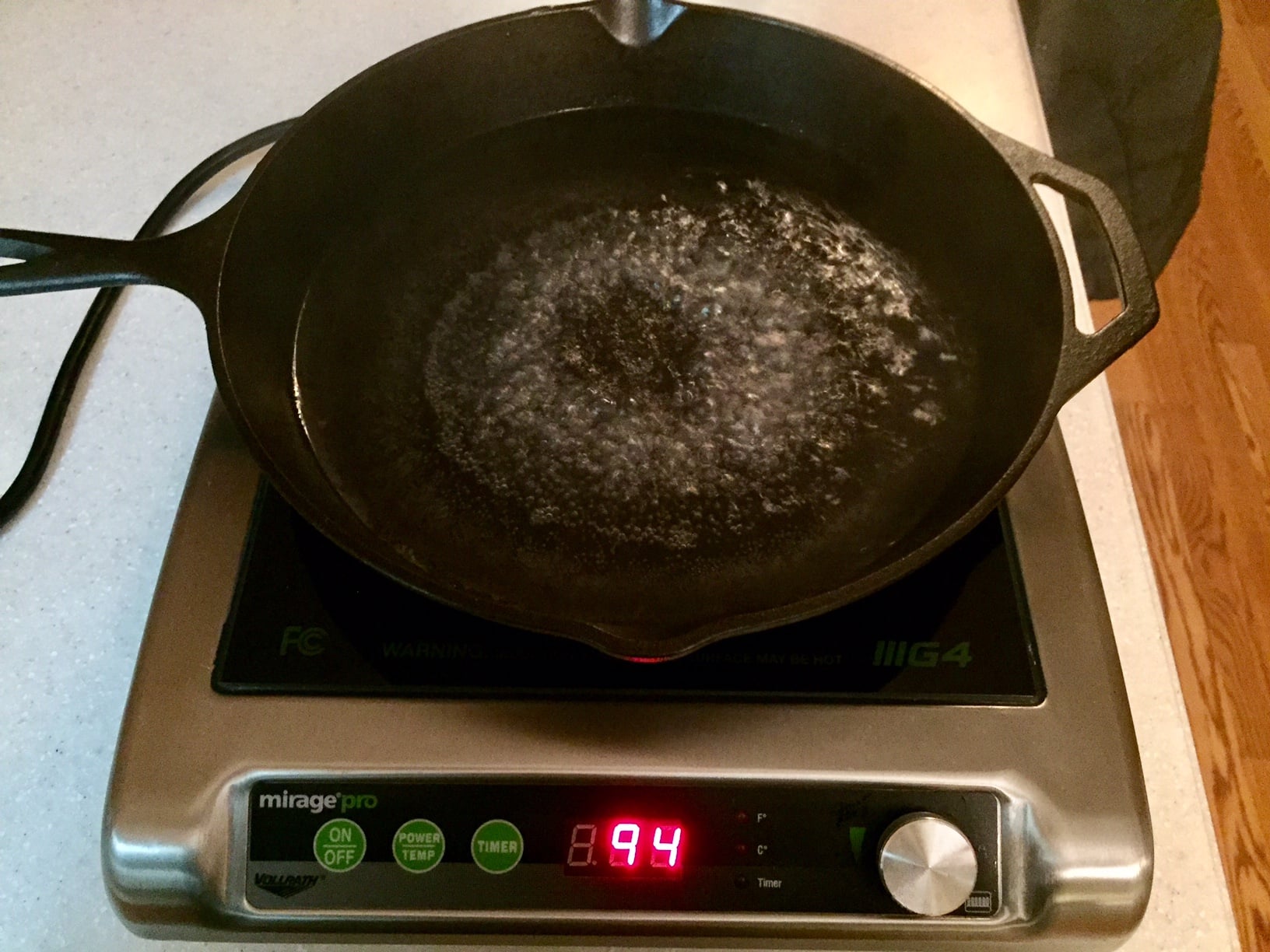
If you guessed "right under the only part of the pan that's actually boiling," you'd be 100% correct. Now imagine that instead of a pan, you had a heavy slab of flat steel that you wanted to cook on. Like, say, the Modernist Cuisine edition Baking Steel. I just so happen to have one of those, so I removed the Lodge and put the MCBS on my Mirage Pro and fired it up. After five minutes of pre-heating, the center was around 430F, but the edges were only warm to the touch. I turned the heat down a little bit and let it continue to warm up for an additional 10 minutes. After 15 minutes on the heat, the surface in the center had stabilized (at the new, lower power) at 415F. Just one inch away from the induction coil and the heat dropped off between 85 and 100 degrees. IN AN INCH. Things only got worse as you moved out to the edges. But even if I confined my measurements to the black area of the cooktop, the corners of that space were only registering 210 or so... more than 200 degrees cooler than the center, only a few inches away. I really wish I had a thermal imaging camera to show you how crappy and uneven the heat was. But you'll just have to take my word that it's pretty crappy and uneven. That's what happens when you use a spotty heat source with a poor conductor. The fantasy of making a trio of perfectly-cooked eggs on a steel griddle using a portable induction hob is just that: a fantasy. (Sorry Modernist Cuisine.) You could probably use it for pancakes... but you'd have to be aware that some pancakes would cook twice as fast as others (and some might not cook at all).
I'm happy to report that the steel works swimmingly on gas burners. It used to live on top of the gas range at my old house. I've since moved to a house with a smooth electric (ugh) cooktop, so the steel has been retired as a griddle. And now it just sort of sits on top of my toaster oven looking unloved. Sorry, steel. One day you'll be back in my everyday rotation, my love... on a day that I'm cooking with gas again.


